

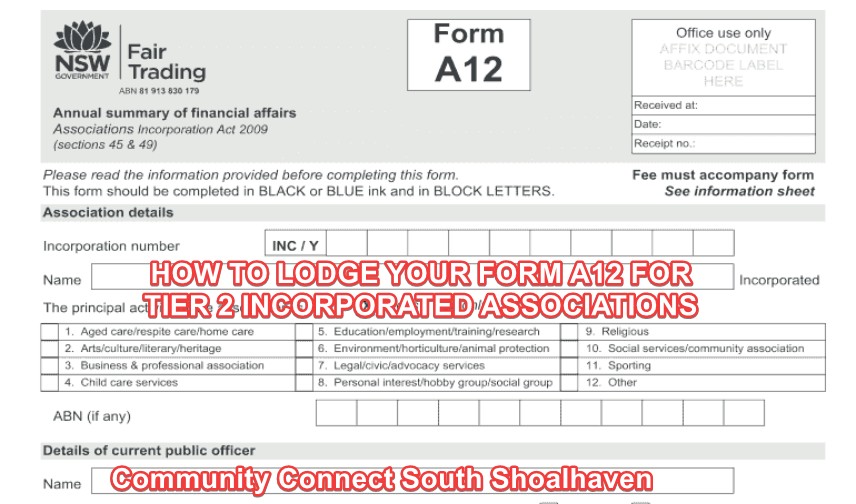
Your Annual Form A12-T2: A Simple Guide for NSW Incorporated Groups
Every year, thousands of small and medium not-for-profits across New South Wales need to lodge their annual financial summary with NSW Fair Trading. If your group is an incorporated association — think community groups, sports clubs, neighbourhood centres, local charities, or cultural organisations — this guide is for you.
First things first: Do you actually need to lodge this form?
If your organisation is registered as an incorporated association in NSW, the answer is almost certainly Yes.
The one big exception: if your group is also registered as a charity with the Australian Charities and Not-for-profits Commission (ACNC), you may be exempt from lodging with NSW Fair Trading. Instead, you’d lodge your Annual Information Statement with the ACNC, which then shares the information with Fair Trading on your behalf. If you’re not ACNC-registered, read on — this guide is exactly what you need.
What’s a Tier 2 association?
NSW Fair Trading splits incorporated associations into two tiers based on their size. Tier 2 (small) is the category most community groups and small NFPs fall into.
You are a Tier 2 association if, in your last financial year, your organisation had:
- Total revenue (gross receipts) of $500,000 or less,
AND - Current assets of $1,000,000 or less
Current assets means things like cash in the bank, term deposits, or shares — not buildings or equipment.
Heads up: These thresholds were updated on 27 June 2025 (previously $250,000 revenue and $500,000 assets). If your group was borderline before, you may now comfortably sit in Tier 2.
If your revenue or assets exceed those limits, you’d be a Tier 1 association with additional reporting requirements — but that’s a separate guide.
What is the Form A12-T2?
The Form A12-T2 — Annual Summary of Financial Affairs (Tier 2) is the yearly compliance form that Tier 2 associations must lodge with NSW Fair Trading. It’s a summary snapshot of your finances and key details, not a full financial audit.
Think of it as your association’s annual “check-in” with the state government — confirming you’re still operating, who’s in charge, and broadly how your finances look.
When do you need to lodge?
You must lodge the form by whichever of these dates comes first:
- Within one month after your Annual General Meeting (AGM),
OR - No later than seven months after the end of your financial year
So if your financial year ends 30 June, your AGM should happen by 31 December, and the form is due no later than 31 January — or within one month of your AGM, if that’s sooner.
Important: Your financial statements must be presented to members at the AGM before you can lodge the form.
The current fee at time of writing is $57.00 can can be paid via credit card online.
Late fees apply
If you miss the one-month window after your AGM, a higher lodgement fee kicks in. The current fee is displayed on the online form itself, and it increases the longer you leave it. Lodge on time to keep costs down.
Need more time? If your association can’t hold its AGM within six months of the financial year end, or can’t lodge by the due date, you can apply for an extension using Form A11. Don’t wait until the last minute — apply early.
What information do you need to have ready?
Before you sit down to fill in the form, gather these details. It’ll make the whole process much quicker.
1. Your association’s details
- The full legal name of your association exactly as it appears on the register
- Your incorporation number (this starts with “Y” — e.g. Y1234567)
- Not sure of your number? Look it up on the NSW Incorporated Associations Online Register
2. Principal activity
You’ll need to select one category that best describes what your association does — things like sport and recreation, social services, arts, education, religious activities, and so on.
3. Public officer details
- The current public officer’s full name
- Their contact phone number and email
- The official address of the association — note this cannot be a PO Box, it must be a street address
If your public officer or official address has changed since you last lodged, you’ll also need to submit a Form A9 — Notice of Appointment of Public Officer and Change of Address at the same time.
4. Financial year and AGM dates
- The end date of your financial year (e.g. 30 June 2025)
- The date your AGM was held
Remember: the AGM must be held after the end of the financial year, not before.
5. Financial summary
Tier 2 (small) Associations no longer need to lodge financial information on their A12 form.
Simply answer the questions on the form regarding Revenue and Assets
(See ‘What’s a Tier 2 association?‘ details above)
6. Membership numbers
You’ll confirm:
- Total number of financial members
- Number of committee members
Your association must have at least 5 members and at least 3 committee members to remain incorporated.
7. Declaration
A committee member authorised by the committee must sign off on the form. Online lodgement uses a digital declaration.
How to lodge online
The easiest and fastest way to lodge is online through the NSW Fair Trading digital platform.
👉 Lodge Form A12-T2 online here
Here’s what the process looks like:
- Go to the link above
- Fill in your association’s details section by section (the form guides you through it)
- Enter your financial summary figures
- Complete the declaration
- Pay the lodgement fee — this is done at the end of the online form process. Do not pay via a separate Service NSW payment portal before starting the form; payment is handled within the form itself
Payment can be made by credit or debit card online. The exact fee will be displayed when you complete the form.
Handy tip: Before you start, verify your association’s name and registration number using the NSW Incorporated Associations Online Register — this ensures you’re entering the correct details.
Other ways to lodge
If you prefer not to lodge online, you have two other options:
By email: Send the completed form to registrylodgements@customerservice.nsw.gov.au. In the subject line, include the full name of your association and its registration number. Note that cheque payments are not accepted by mail — you’ll need another payment method.
In person: Visit a Service NSW centre. Some centres accept cheque payments — call 13 77 88 before visiting to confirm payment options at your nearest centre.
Quick checklist before you lodge
Use this as your final check before hitting submit:
- AGM has been held and financial statements were presented to members
- Association name and incorporation number confirmed on the register
- Public officer’s current details on hand (name, phone, email, street address)
- Financial figures meet the Tier 2 limits
- Current membership numbers meet the minimum requirements
- Any changes to public officer or address? If yes, prepare Form A9 as well
- Payment method ready (credit/debit card for online lodgement)
Need help?
If you get stuck or have questions, NSW Fair Trading has a helpful team available:
- Phone: 1800 502 042 (Monday to Friday, 8:30am–5:00pm)
- More information: NSW Fair Trading — Tier 2 Financial Reporting
- All forms and fees: NSW Incorporated Associations Forms and Fees
- Service NSW transaction page: Lodge Annual Summary — Service NSW
Of course you can always reach out to Community Connect South Shoalhaven if you have a specific question or issue. Send us an email or leave a message on our contact page
The bottom line
Lodging your Form A12-T2 is simple and easy online. Do it promptly after your AGM, and you’ll avoid late fees and the stress of chasing a deadline. Your group works hard for your community. A little annual paperwork is a small price to pay for the legal protection and credibility that comes with being incorporated.
This guide reflects requirements current as of mid-2025, including the updated financial reporting thresholds effective 27 June 2025. Always check NSW Fair Trading for the most up-to-date information before lodging.